Get this book

Amazon
Books & Kindle

Audible
Audiobook

Bookshop.org
Support indie stores
Affiliate links — I earn a small commission if you buy, at no extra cost to you. Learn more
Data via openlibrary
Age of Reason
No ratings yet
<p><i>The Age of Reason</i> is an important work in the American Deist movement. <a href="https://standardebooks.org/ebooks/thomas-paine">Paine</a> worked on it continually for more than a decade, publishing it in three parts from 1794 through 1807. It quickly became a best-seller in post-Revolution America, spurring a revival in Deism as an alternative to the prevailing Christian influence.</p> <p>In clear, simple, and often funny language, Paine attempts to dissect the Bible’s supposed inaccuracies and hypocrisies. He portrays the Bible as a human construct, full of illogic, errors, and internal inconsistencies, as opposed to it being a text born of divine inspiration. On those arguments he pivots to decrying not just Christianity, but organized religion as a whole, as a human invention created to terrorize and enslave. Instead of accepting organized religion, he states that “his mind is his own church” and that man must embrace reason.</p> <p>While these arguments weren’t new to the wealthy and educated class of the era, they <em>were</em> new to the poor masses. The book was at first distributed as cheap unbound pamphlets, making it easily accessible to the poor; and Paine’s simple language was written in way the poor could understand and sympathize with. This made the powerful very nervous, and, fearing that the book could cause a potential revolution, Paine and his publishers were suppressed.</p> <p>Paine wrote <i>The Age of Reason</i> while living in Paris. In France, its thesis wasn’t revolutionary <em>enough</em> for the bloodthirsty Jacobins; he was imprisoned there for ten months and only escaped execution through a stroke of luck. Meanwhile in Britain, the government considered the pamphlets seditious. British booksellers and publishers involved in printing and distributing the pamphlets were repeatedly tried for seditious and blasphemous libel, with some even receiving sentences of hard labor.</p> <p>Paine began writing Part III after escaping France for America, but even the American elite thought the book too scandalous, with Thomas Jefferson—himself a Deist—advising Paine not to publish. Paine listened to Jefferson’s advice and held off publishing Part III for five years before publishing extracts as separate pamphlets. For that reason, Part III is not a concrete publication, but rather an arrangement of several loosely-related pamphlets organized at the discretion of an edition’s editor.</p> <p>Once it was in the hands of Americans, it sparked a revival in Deism in the United States before being viciously attacked from all sides. Paine earned a reputation as an agitator and blasphemer that stuck to him for the rest of his life.</p> <p>Despite <i>The Age of Reason</i>’s harsh reception—or perhaps, <em>because</em> of it, and the controversy and discussion it caused—it achieved a popularity in England, France, and America that gave it incredible influence in those nation’s perspectives on organized religion.</p>
Get this book
Amazon
Books & Kindle
Audible
Audiobook
Bookshop.org
Support indie stores
Affiliate links — I earn a small commission if you buy, at no extra cost to you. Learn more
Creators

More by Thomas Paine
Full filmography →
Apollo 13: Survival
2024

Prentice Hall Literature--Timeless Voices, Timeless Themes--The American Experience
1999

Prentice Hall Literature--The American Experience
1989
![The United States in Literature [with three long stories] -- Seventh Edition](https://covers.openlibrary.org/b/id/6699609-M.jpg)
The United States in Literature [with three long stories] -- Seventh Edition
1952
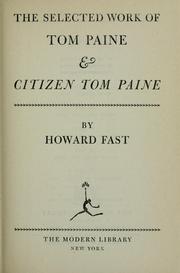
The selected work of Tom Paine & Citizen Tom Paine
1945
Dissertation on first-principles of government
1795

The Age of Reason
1794
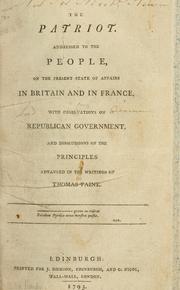
The patriot
1793