Get this book

Amazon
Books & Kindle

Audible
Audiobook

Bookshop.org
Support indie stores
Affiliate links — I earn a small commission if you buy, at no extra cost to you. Learn more
Data via openlibrary
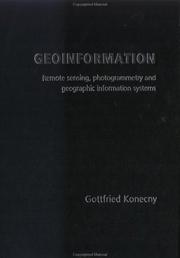
Geoinformation
No ratings yet
"Preface In the 1990s, surveying and mapping underwent a transition from disciplineoriented technologies, such as geodesy, surveying, photogrammetry, and cartography, to the methodology-oriented integrated discipline of geoinformatics. This is based on Global Navigation Satellite System (GNSS), or GPS, positioning, remote sensing, digital photography for data acquisition, and a geographic information system (GIS) for data manipulation and data output. This book attempts to present the required basic background for remote sensing, digital photogrammetry, and GIS in the new geoinformatics concept in which the different methodologies must be combined. For remote sensing, the basic fundamentals are the properties of electromagnetic radiation and their interaction with matter. This radiation is received by sensors and platforms in an analogue or digital form, and is subject to image processing. In photogrammetry, the stereo concept is used for the location of information in 3D. With the advent of high-resolution satellite systems in stereo, the theory of analytical photogrammetry restituting 2D image information into 3D is of increasing importance, merging the remote sensing approach with that of photogrammetry. The result of the restitution is a direct input into geographic information systems in vector or raster form. The fundamentals of these are described in detail, with an emphasis on global, regional, and local applications. In the context of data integration, a short introduction to the GPS satellite positioning system is provided. This book will appeal to a wide range of readers from advanced undergraduates to all professionals in the growing field of geoinformation"--
Get this book
Amazon
Books & Kindle
Audible
Audiobook
Bookshop.org
Support indie stores
Affiliate links — I earn a small commission if you buy, at no extra cost to you. Learn more