Get this book

Amazon
Books & Kindle

Audible
Audiobook

Bookshop.org
Support indie stores
Affiliate links — I earn a small commission if you buy, at no extra cost to you. Learn more
Data via openlibrary
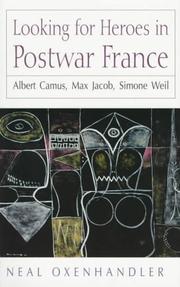
Looking for Heroes in Postwar France
No ratings yet
This is the story of a love affair with a culture - a 50-year involvement that shaped at the very deepest levels its protagonist's philosophy, his identity, his life. In this elegant piece of "memoir criticism," a genre originated by Montaigne but finding renewed life in recent years, Neal Oxenhandler examines the impact of Camus, Jacob, and Weil on his own evolution as a writer, a scholar, and a human being. He finds subtle and surprising commonalities among the three writers, a harmony that motivated him to spell out their place in the postwar literary scene. Doing so, he began to unravel his own personal "craziness." He writes: "They taught me morality, politics, and religion, they gave me clues to secret parts of my psychic life." . Oxenhandler begins with his first Atlantic crossing, as a GI in World War II, then recounts his postwar return when traces of these writers were still intact. "I could walk down their streets, read their books, interview their friends." Now from the perspective of five decades he contemplates the contributions of each figure, both to intellectual history and to his own awakening. Camus, he says, combined political relevance and artistic achievement, serving as a witness against evil in the post-Vichy period. Jacob died in the Drancy prison camp at war's end. In Oxenhandler's reassessment, Jacob becomes a witness to the Holocaust, even though a Catholic convert. Weil, self-exiled Jew, dying of hunger in a protest against the German occupation of France, is viewed by Oxenhandler as a transgressive figure of controversy, too absolute to survive the contradictions of the modern world. From these lives, these deaths the author devises a new type of "mediated autobiography" to connect text, narrative, and personal identity.
Get this book
Amazon
Books & Kindle
Audible
Audiobook
Bookshop.org
Support indie stores
Affiliate links — I earn a small commission if you buy, at no extra cost to you. Learn more