Get this book

Amazon
Books & Kindle

Audible
Audiobook

Bookshop.org
Support indie stores
Affiliate links — I earn a small commission if you buy, at no extra cost to you. Learn more
Data via openlibrary
Peace papers
No ratings yet
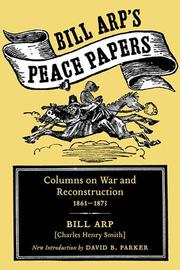
First published in 1873, Bill Arp's Peace Papers, by Charles Henry Smith (1826-1903), is a collection of writings from the Civil War and Reconstruction by the Confederacy's most famous humorist. Smith, a lawyer in Rome, Georgia, took the penname "Bill Arp" in April 1861, following the firing on Fort Sumter, when he wrote a satiric response to Abraham Lincoln's proclamation ordering the Southern rebels to disperse within twenty days. In his letter addressed to "Mister Linkhorn" and written in the semiliterate backwoods dialect adopted by numerous mid-nineteenth-century humorists, Smith advised the president, "I tried my darndest yisterday to disperse and retire... but it was no go." The "Linkhorn" letter, reprinted in many Southern newspapers, was wildly popular across the South, and Smith followed it with dozens of other similarly comic pieces over the next few years, all signed by "Bill Arp." During the war he mocked Lincoln and praised the bravery and sacrifice of the Confederates, but he also turned a disapproving eye on those Southerners--from draft dodgers to Georgia governor Joe Brown--whose actions he viewed as detrimental to the war effort. Following the war he turned his attention to criticizing Reconstruction efforts to reshape Southern race relations. Later Smith collected the best of these pieces in Bill Arp's Peace Papers, a valuable example of the Southern conservative perspective on the Civil War and Reconstruction era. This Southern Classics edition makes Smith's witticisms as Arp available once more, augmented with a new introduction by Georgia historian David B. Parker, which places the writings and their author in historical and literary context. --Publisher description.
Get this book
Amazon
Books & Kindle
Audible
Audiobook
Bookshop.org
Support indie stores
Affiliate links — I earn a small commission if you buy, at no extra cost to you. Learn more


![The Collected Works of Ambrose Bierce, Volume II. In the Midst of Life (Tales of Soldiers and Civilians) [15 stories]](https://covers.openlibrary.org/b/id/12670963-M.jpg)