
Get this book

Amazon
Books & Kindle

Audible
Audiobook

Bookshop.org
Support indie stores
Affiliate links — I earn a small commission if you buy, at no extra cost to you. Learn more
Data via openlibrary
Poetic trespass
No ratings yet
A Palestinian-Israeli poet declares a new state whose language, "Homelandic", is a combination of Arabic and Hebrew. A Jewish-Israeli author imagines a "language plague" that infects young Hebrew speakers with old world accents, and sends the narrator in search of his Arabic heritage. In 'Poetic Trespass', Lital Levy brings together such startling visions to offer the first in-depth study of the relationship between Hebrew and Arabic in the literature and culture of Israel/Palestine. More than that, she presents a captivating portrait of the literary imaginations power to transgress political boundaries and transform ideas about language and belonging.0Blending history and literature, 'Poetic Trespass' traces the interwoven life of Arabic and Hebrew in Israel/Palestine from the turn of the twentieth century to the present, exposing the two languages intimate entanglements in contemporary works of prose, poetry, film, and visual art by both Palestinian and Jewish citizens of Israel. In a context where intense political and social pressures work to identify Jews with Hebrew and Palestinians with Arabic, Levy finds writers who have boldly crossed over this divide to create literature in the language of their "other", as well as writers who bring the two languages into dialogue to rewrite them from within.0Exploring such acts of poetic trespass, Levy introduces new readings of canonical and lesser-known authors, including Emile Habiby, Hayyim Nahman Bialik, Anton Shammas, Saul Tchernichowsky, Samir Naqqash, Ronit Matalon, Salman Masalha, A. B. Yehoshua, and Almog Behar. By revealing uncommon visions of what it means to write in Arabic and Hebrew, 'Poetic Trespass' will change the way we understand literature and culture in the shadow of the Israeli-Palestinian conflict.
Get this book
Amazon
Books & Kindle
Audible
Audiobook
Bookshop.org
Support indie stores
Affiliate links — I earn a small commission if you buy, at no extra cost to you. Learn more
Creators
More like this
al-Naqd al-adabī wa-dawruhu fī al-mujtamaʻāt al-ʻArabīyah
2007
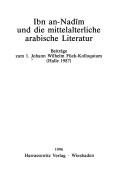
Ibn an-Nadīm und die mittelalterliche arabische Literatur
1996
al-Inḥirāf al-ʻaqadī fī adab al-ḥadāthah wa-fikrihā
2003
معايير النقد الأدبي في القرن الرابع الهجري
2009
al- Adab al-ʻArabī min ẓuhūr al-Islām ilá nihāyat al-ʻAṣr al-Rāshidī, 1 H-40 H
1995

Palestinian literature and film in postcolonial feminist perspective
2012