Get this book

Amazon
Books & Kindle

Audible
Audiobook

Bookshop.org
Support indie stores
Affiliate links — I earn a small commission if you buy, at no extra cost to you. Learn more
Data via openlibrary
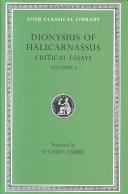
The critical essays in two volumes
No ratings yet
DIONYSIUS OF HALICARNASSUS migrated to Rome in 300 B.C., where he lived until his death some time after 8 B.C., writing his Roman Antiquities in twenty books and teaching the art of rhetoric and literary composition to a small group of upper-class Romans. His purpose, both in his own work and in his teaching, was to re-establish the classical Attic standards of purity, invention and taste in order to reassert the primacy of Greek as the literary language of the Mediterranean world. The essays in the present volume display the full range of Dionysius' critical expertise. In the treatise On Literary Composition, his finest and most original work, discussion of the effects produced by the arrangement of words involves minute analysis of phonetics and metre in addition to more general aspects of literary aesthetics such as the difference between poetry and prose, and the tripartite classification of the types of arrangement. The other four essays are on a less ambitious scale. The Dinarchus is primarily a study of authenticity in which Dionysius attempts to identify the genuine speeches of the latest Attic orator from the list of those ascribed to him by the librarians. The three literary letters are all concerned with possible models. In the Letter to Pompeius, Dionysius gives his reasons for criticizing Plato on stylistic and also moral grounds, and appends critiques of Herodotus, whom he greatly admired, and three other historians -- Xenophon, Philistus and Theopompus. Of the two Letters to Ammaeus, the second may be read as an appendix to the Thucydides, but the first concerns literary history, and investigates the question of whether Demosthenes could have learnt his oratorical skills from Aristotle's Rhetoric. Volume I contains the essays On the Ancient Orators, Lysias, Isocrates, Isaeus, Demosthenes, and Thucydides.
Get this book
Amazon
Books & Kindle
Audible
Audiobook
Bookshop.org
Support indie stores
Affiliate links — I earn a small commission if you buy, at no extra cost to you. Learn more
Creators

Sobre La Composicion Literaria, Sobre Dinarco
2001
Sobre la composición literaria ; Sobre Dinarco ; Primera carta a Ameo ; Carta a Pompeyo Gémino ; Segunda carta a Ameo
2001
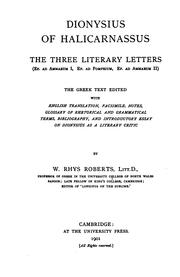
The three literary letters
1901
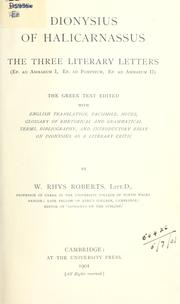
The three literary letters, Ep. ad Ammaeum I, Ep. ad Pompeium, Ep. ad Ammaeum 2
1901
Dionysii Halicarnassensis Historiographica
1823
Dionysii Halicarnassensis Opera omnia
1774