Get this book

Amazon
Books & Kindle

Audible
Audiobook

Bookshop.org
Support indie stores
Affiliate links — I earn a small commission if you buy, at no extra cost to you. Learn more
Data via openlibrary
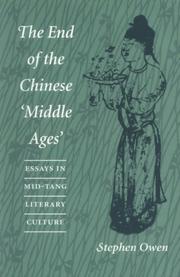
The end of the Chinese 'Middle ages'
No ratings yet
This book explores, through a series of essays, a set of interrelated elements that define the literary culture of China in the late eight and early ninth centuries. This period, known as the Mid-Tang, broke with many of the intellectual habits of the "middle period" of Chinese culture and adumbrated many of the characteristics of China in the Song and later periods. The first essay examines "singularity," representations of identity as an assertion of superiority over others and as an alienation that brings rejection by others. The second essay addresses different ways of representing landscapes, showing the ways in which the underlying order of nature had become a problem in the Mid-Tang. The third essay discusses the tendency to offer hypothetical explanations for phenomena that either run contrary to received wisdom or try to account for situations usually thought not to require explanation. When carried out at the level of pure play, such subjective acts of interpretation are wit, and the fourth essay analyzes playfully inflated interpretations of domestic spaces and leisure activities as a discourse of private valuation, articulated against commonsense values. . The fifth essay takes up some fundamental changes in the way writing, especially the writing of poetry, was represented in the Mid-Tang. In this period, writers began talking about poetry as an "art," and the poet is seen as someone with special talents who works on a piece over time and shapes it according to the demands of art. The two final essays treat classical tales from the new culture of romance that took shape late in the eighth century.
Get this book
Amazon
Books & Kindle
Audible
Audiobook
Bookshop.org
Support indie stores
Affiliate links — I earn a small commission if you buy, at no extra cost to you. Learn more