Get this book

Amazon
Books & Kindle

Audible
Audiobook

Bookshop.org
Support indie stores
Affiliate links — I earn a small commission if you buy, at no extra cost to you. Learn more
Data via openlibrary
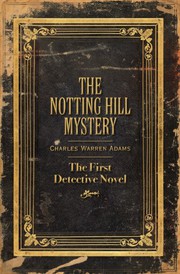
The Notting Hill Mystery
No ratings yet
From Wikipedia: "Source documents compiled by insurance investigator Ralph Henderson are used to build a case against Baron "R___", who is suspected of murdering his wife. The baron's wife died from drinking a bottle of acid, apparently while sleepwalking in her husband's private laboratory. Henderson's suspicions are raised when he learns that the baron recently had purchased five life insurance policies for his wife. As Henderson investigates the case, he discovers not one but three murders. The plot hinges on the dangers of mesmerism, a subject explored in fiction earlier by Isabella Frances Romer. Although the baron's guilt is clear to the reader even from the outset, how he did it remains a mystery. Eventually this is revealed, but how to catch him becomes the final challenge; he seems to have committed the perfect crime." "Some critics – including Julian Symons, a crime writer and poet – believe it to be the first modern detective novel, though it was later overshadowed by works by Wilkie Collins and Émile Gaboriau, which usually receive that accolade. Some aspects of detective fiction can also be found in R. D. Blackmore's sensation novel Clara Vaughan (written in 1853, published in 1864), about the daughter of a murder victim seeking her father's killer, but Adams's novel contains several innovations, such as the main character presenting evidence of his own findings through diary entries, family letters, depositions, chemical analysts report and crime scene map. These techniques would not become common until the 1920s. Symons said it "quite bowled me over" how far ahead of its time it was."
Get this book
Amazon
Books & Kindle
Audible
Audiobook
Bookshop.org
Support indie stores
Affiliate links — I earn a small commission if you buy, at no extra cost to you. Learn more