Get this book

Amazon
Books & Kindle

Audible
Audiobook

Bookshop.org
Support indie stores
Affiliate links — I earn a small commission if you buy, at no extra cost to you. Learn more
Data via openlibrary
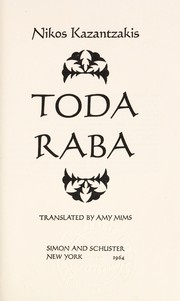
Toda-Raba
No ratings yet
[Translated by Amy Mims.] Toda Raba was written in 1929, after Kazantzakis’ return from his journeys through the Soviet Union. It is a novel — strange, surging, mystical and, in the final analysis, terrifyingly prophetic. The characters are — with one exception — reflections of Kazantzakis himself, and represent his own deeply conflicting views of the Revolution. They are all wanderers, searchers, drawn by the force of Lenin (who has already died) to the Soviet Union, at a time when Russia is still living in the aftermath of the Civil War. There is Rahel, a Polish-Jewish girl, drawn to Communism and working for the secret police; there is Azad, the ex-Cheka murderer, who believes in the necessity for a new and purer revolution, and thinks Communism must come from a change of man’s soul, not from the machines and the materialism of Europe and America; there is Geranos, a Cretan like Kazantzakis, by far the most rational and comprehensible of the characters, who admires the Revolution but is too old to join in its works, too set in his mental habits to abandon himself to it; there is Sou-ki, a Chinese from California; and Amita, a Japanese writer; and Ananda, an Indian monk — all these meet, talk, think, analyze the Revolution and the Soviet Union. Towering over them all, in a mysterious way, is Toda Raba, an African Negro who abandons his tribe and his savage god to make a pilgrimage to Russia. And it is he, with his violence, his paganism and his humanity, who represents the wave of the future, not the others, who represent, each in his or her own way, the old races and the old civilizations. Toda Raba is the man of the future, and the Russian Revolution releases his energy and his sense of his own destiny. There is a terrifying scene at an Asian Congress in the U.S.S.R., in which the Asians cry out for revenge and declare that the future of the world is with them and with Africa, not with the West, not even with the new Russia. In this sense the novel is prophetic, and Kazantzakis understood even in 1929 that the Russian Revolution’s importance was far greater than the effects it had on Russia herself, and that the echoes of it would awake the vast areas of Africa and Asia that had been silent for centuries.
Get this book
Amazon
Books & Kindle
Audible
Audiobook
Bookshop.org
Support indie stores
Affiliate links — I earn a small commission if you buy, at no extra cost to you. Learn more