Get this book

Amazon
Books & Kindle

Audible
Audiobook

Bookshop.org
Support indie stores
Affiliate links — I earn a small commission if you buy, at no extra cost to you. Learn more
Data via openlibrary
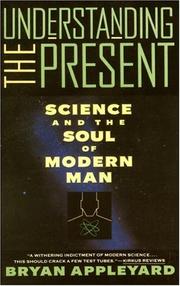
Understanding the present
No ratings yet
The book explores the history of science, from the dawn of the Enlightenment up to the present day, arguing that its triumph in almost every sphere of human activity, spectacular though it is, has come at a high price. In spite of its effectiveness — or, indeed, because of it — science has cut the individual adrift from his moorings, depriving him not only of a sense of ultimate meaning and purpose but also from the possibility of ever finding them. For science denies the conviction that value and meaning can be found in the facts of the world and, worse still, defines all truths as provisional, as hypotheses yet to be verified or refuted. [...] If science were merely a methodology, this would not be a serious problem. But today science has become the dominant way of understanding the world and our place in it. It shapes our political lives, our economics, our health, and [...] even our understanding of ourselves. [...] Appleyard devotes a chapter each to the emergence of environmentalism as a new kind of religion and to the metaphysical speculations accompanying advances in relativity, quantum mechanics, and chaos theory — the three major scientific achievements of the twentieth century. In both cases, he is sympathetic but ultimately skeptical that these developments can relieve the existential crisis brought on by the rise of the scientific worldview. He is especially wary of scientists like Stephen Hawking and Carl Sagan who believe in the possibility of a grand, unifying "Theory of Everything," or those champions of artificial intelligence who are working on the construction of "conscious" machines. As Appleyard sees it, [...] science must be recognized for what it is: "a form of mysticism that proves peculiarly fertile in setting itself problems which only it can solve." [...][excerpted from a review by Scott London [[1]], 1997] [1]: http://www.scottlondon.com/reviews/appleyard.html
Get this book
Amazon
Books & Kindle
Audible
Audiobook
Bookshop.org
Support indie stores
Affiliate links — I earn a small commission if you buy, at no extra cost to you. Learn more